Brazil is carrying out the biggest reform of its tax system in decades. It’s designed to simplify the country’s complex consumption taxes by replacing several existing taxes with a new value-added tax (VAT) model.
For businesses in Brazil, though, this is far more than a change in rates. It affects pricing, invoicing, supply chains, contracts, cash flow and the way you manage your tax and ERP systems. The new system is being introduced gradually between 2026 and 2033, so you’ll operate in a changing tax environment for years. Whether you’re already active in Brazil or planning to enter, you need to know what’s changing, when it happens and how it may affect your business. This guide explains the reform in practical terms.
Why Brazil Is Reforming Its Tax System
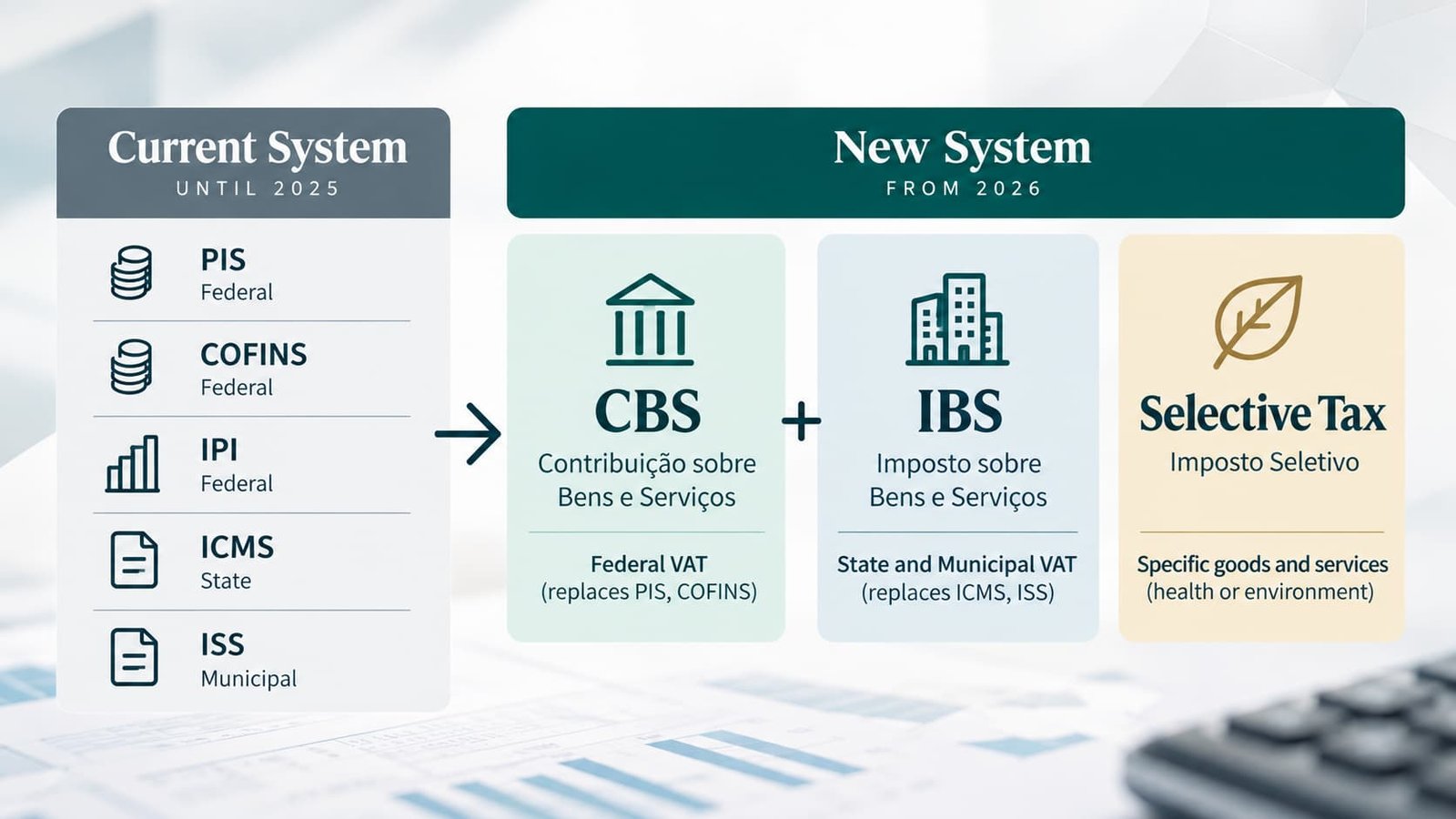
Brazil has one of the most complex consumption tax systems in the world. Taxes on goods and services are levied at federal, state and municipal level, each with its own rules, rates and calculation methods. The main ones are PIS, COFINS and IPI at federal level, ICMS at state level (on the circulation of goods and certain services) and ISS at municipal level (on services).
These taxes have different tax bases, credit mechanisms and sector-specific provisions, and there are countless incentives on top. Credits exist for some inputs, but not consistently, so tax gets carried along the supply chain instead of falling only on final consumption. ICMS rules, rates and incentives differ from state to state, and ISS is set by each municipality, which complicates every transaction across regional boundaries. The result is a system that is hard to administer and expensive to comply with.
The reform replaces this fragmented structure with a dual VAT. It was introduced by Constitutional Amendment 132/2023 and put into practice through Complementary Laws 214/2025 and 227/2026. Between 2026 and 2033, the old and new systems run side by side.
The New Tax Model: CBS, IBS and the Selective Tax
The new system rests on three taxes. CBS (Contribuição sobre Bens e Serviços) is a federal tax that replaces PIS and COFINS. IBS (Imposto sobre Bens e Serviços) replaces ICMS and ISS and is administered jointly by the states and municipalities through the Comitê Gestor do IBS. Together, CBS and IBS form the dual VAT. They’re run by different levels of government but follow broadly aligned rules and generally apply to the same transactions. Both are non-cumulative, so tax paid on eligible purchases generally generates credits.
IPI isn’t replaced by a new tax. Its rate drops to zero for almost all products from 2027, with an exception for products that are also made in the Manaus Free Trade Zone.
The Selective Tax (Imposto Seletivo, IS) sits outside the VAT system. It applies only to specific goods and services considered harmful to health or the environment, so a transaction can be subject to CBS and IBS without the Selective Tax applying.
The Transition Period: 2026–2033
The new system doesn’t replace the old one overnight. It arrives in stages, and you’ll need to operate in a changing framework throughout.
2026: the test year. CBS and IBS are tested at indicative rates of 0.9% and 0.1%. The amounts are offset against PIS and COFINS and, under the applicable rules, other federal taxes, so they add no real burden. The purpose is to let the authorities, businesses and systems adjust before the main transition starts. Companies do have to adapt their electronic tax documents to identify CBS and IBS.
2027–2028: CBS takes over. From 2027, CBS is fully effective and PIS and COFINS are abolished. The Selective Tax is introduced, and IPI drops to zero for almost all products, except those also made in the Manaus Free Trade Zone. IBS continues at a transitional rate while ICMS and ISS remain in place.
2029–2032: ICMS and ISS give way to IBS. Over these four years, the state and municipal taxes are reduced step by step while IBS grows. In 2029, IBS accounts for 10% and ICMS and ISS for 90%. That becomes 20% and 80% in 2030, 30% and 70% in 2031, and 40% and 60% in 2032. These percentages describe the proportions in which the taxes apply, not the tax rates themselves.
2033: the new system in full. ICMS and ISS cease to exist, and CBS and IBS run under the new framework. IPI’s role is limited to the Manaus exception.
In short, the federal part changes quickly from 2027, while the state and municipal part moves more gradually between 2029 and 2033.
How the New VAT System Works
The dual VAT works through credits. Say a manufacturer buys raw materials and pays CBS and IBS on them. When it sells the finished product, it charges CBS and IBS to the next party in the chain, and can deduct the tax it paid on the inputs. This continues along the supply chain until the product reaches the final consumer, who gets no credit. That’s where the tax is ultimately borne. Tax applies to the value added at each stage instead of piling up through successive transactions.
The second big change is destination-based taxation. Today, tax treatment can depend heavily on where goods are produced, sold or where services are provided. Under the new model, IBS revenue goes to the place where consumption takes place, which is particularly relevant for sales across states and municipalities and should reduce tax competition between them.
The new system also makes the tax component of a transaction more transparent. Instead of several consumption taxes buried in the price, it has clearly defined VAT components. A broader credit mechanism, destination-based taxation and more standardised rules add up to a more consistent way of taxing consumption across Brazil.
Sectors and Special Regimes
The general CBS and IBS principles apply broadly, but the reform is not uniform. The impact differs by business, and many sectors have their own rules.
Manufacturing sees the biggest change in how tax builds up through production stages. The broader credit mechanism should reduce cascading, IPI disappears in practice and the Selective Tax may apply to specific products. Retail and distribution are most affected by the destination principle, especially for sales between states. Services, now taxed through ISS, PIS and COFINS, generally move into CBS and IBS, and the same applies to digital products, platforms and other technology-based business models. Agribusiness and food have specific provisions, including possible reduced rates. Construction and real estate and financial services each have their own rules for calculating the tax base.
On top of that come the special regimes. Simples Nacional, the simplified regime for micro and small businesses, continues to exist, with its own rules for how CBS and IBS are treated and how credits pass along the chain. Reduced rates and zero rates apply to areas such as healthcare, education and food. Fuels and certain agricultural and food activities also have their own mechanisms. The Manaus Free Trade Zone gets specific treatment as well, which is why IPI doesn’t follow the same path as in the rest of Brazil.
So the standard CBS and IBS rules never tell the whole story. To know what actually applies to a transaction, you need to look at the specific regime, reductions and sector rules.
What Changes for Foreign Companies
The reform doesn’t create a separate system for foreign-owned businesses. The same CBS and IBS framework applies based on the nature and location of the transaction, and specific rules determine how cross-border transactions are treated. What it does change is the taxation of local transactions, imports, services and operations, and the exact impact depends on how your activities in Brazil are structured.
A Brazilian entity moves from the existing consumption taxes to CBS and IBS, which affects the tax on sales and purchases, the treatment of credits and the allocation of tax across transactions. Imports are generally subject to CBS and IBS under the same principles as domestic transactions, and because of the destination principle, taxation follows consumption in Brazil rather than the place of production. Services supplied from abroad to a recipient in Brazil can also fall within the new framework, and the rules determine when CBS and IBS apply and how the tax obligations and credits are handled.
Intercompany transactions need attention too. The reform doesn’t replace Brazil’s transfer pricing rules, but consumption taxes become part of the overall cost analysis. The same goes for credits, whose availability can change the economics of a multinational supply chain, especially for purchases, imports and intercompany services.
Impact on Pricing, Contracts and Business Models
The reform changes how consumption taxes are charged throughout the supply chain, and how tax costs flow between businesses. That affects how you set prices, structure agreements and calculate margins.
You can’t judge the impact by comparing old and new rates. Your effective tax burden depends on your position in the supply chain, the share of taxable inputs you buy and how many credits you can claim. A higher nominal rate doesn’t necessarily mean a higher effective burden if your ability to recover tax on inputs also changes. During the transition you may also need to account for both structures when setting prices.
Long-term contracts deserve particular attention. Changes in taxation can alter the total cost of a transaction even if the price stays the same, so contracts may need to say how tax changes flow through to prices, payments and other commercial terms. Companies may also reassess sourcing, distribution and transaction structures as the new rules phase in.
ERP, Invoicing and Compliance
The reform requires significant changes to the systems that calculate, record and report consumption taxes: accounting, ERP platforms, electronic invoicing and other fiscal technology.
Brazil’s electronic invoicing will progressively carry CBS and IBS information alongside the existing taxes during the transition, so your invoicing must calculate and show the right taxes at every stage. In your ERP, tax codes, rates, calculation logic, fiscal classifications and credit mechanisms all need reviewing. For companies with complex operations, that runs through purchasing and accounts payable, sales and receivables, inventory, pricing, tax calculation, invoicing and reporting.
The reform also makes accurate classification of products and services more important, because the tax treatment can depend on whether something qualifies for a specific regime or reduction. Review your master data to make sure products, services, suppliers and customers are classified correctly. And because old and new systems overlap, test well before each stage takes effect, including tax calculations, invoices, accounting entries, credits and reporting. It’s a systems and process transformation as much as a fiscal one.
What Companies Should Do Now
The transition takes years, but you need to prepare before the existing taxes are fully replaced. A structured approach helps you spot the areas that need attention and avoid last-minute fixes.
Map your current tax position. Identify which taxes apply to your business, products, services and main transactions. That’s your baseline.
Assess the impact of CBS and IBS. Analyse how the new model affects sales, purchases, credits and effective tax costs, including reduced rates, exemptions and sector regimes.
Review pricing and contracts. Check whether tax changes could affect prices, margins or contractual arrangements, especially in long-term agreements.
Prepare your systems. Review tax configuration, classifications, electronic invoicing and reporting, and test against each stage of the transition, not just the 2033 end state.
Review your supply chain and model scenarios. Consider how credits and destination-based taxation could affect purchasing, production and distribution, and use financial modelling to see the effect on tax costs, margins and cash flow under different assumptions.
Monitor regulatory developments. More regulations, technical specifications and guidance will follow, so keep your implementation plan up to date.
Preparation isn’t a one-off exercise. It’s a multi-year process that evolves as the new system is rolled out.
Conclusion
Brazil’s tax reform is a fundamental restructuring of its consumption tax system. The combination of federal, state and municipal taxes gradually gives way to a dual VAT based on CBS and IBS, complemented by the Selective Tax, with important changes starting in 2026 and the new system fully in place in 2033.
The reform aims to create a more consistent and transparent framework, but the effects differ by sector and business model, especially where special regimes or reduced rates apply. For businesses in Brazil, it’s not just a future change in taxation. It’s a gradual transformation that touches tax, commercial processes, technology and planning, and preparing for each stage is essential.
Ipanema International helps international companies stay on top of these changes. We support you with your Brazilian accounting and tax compliance, and with the practical side of running your operations in Brazil, from local representation to day-to-day administration. Get in touch to talk about what the reform means for your business.