Brazil attracted US$9.1 billion in foreign direct investment (FDI) in June 2026, almost three times the US$3.1 billionrecorded in the same month last year, according to the Banco Central do Brasil (BCB).
Over the past twelve months, Brazil received a total of US$89.3 billion in FDI, equal to 3.58% of GDP. That is well above the country’s current account deficit of 2.46% of GDP, meaning Brazil manages to finance its external position through strategic business investments.
The contrast with portfolio investment is interesting. While foreign direct investment increased sharply, portfolio investment recorded a net outflow of US$600 million in June. In other words, international capital is flowing into factories, offices, acquisitions and productive assets rather than financial markets alone. That distinction matters because direct investment means companies are willing to commit capital for years, instead of weeks or months.
The overall external accounts also improved. Brazil’s current account deficit narrowed to US$2.3 billion in June, a decline of 55.8% compared with the same month last year. Exports rose 24.8% to a record US$36.4 billion, while imports increased 15.3% to US$27.6 billion, resulting in a trade surplus of US$8.8 billion.
Higher spending on international travel and transport widened the services deficit, but this was offset by a stronger trade performance. Over the twelve months ending in June, the current account deficit declined from 3.52% to 2.46% of GDP, while Brazil’s international reserves remained substantial at US$367.6 billion.
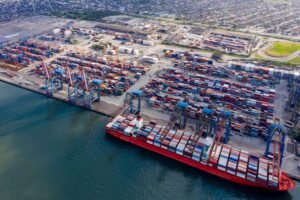
Destinations for the FDI point to Brazil’s traditional sectors. Agriculture remains one of the country’s biggest magnets for international capital, while infrastructure projects are modernising the logistics network needed to support record exports. Energy is another major growth area, as the country is positioning itself as a global hub for renewable energy and green hydrogen.
The recent figures fit a pattern that has become difficult to ignore. Foreign direct investment remained strong over time, exports reach new highs and Brazil’s external accounts are in considerably better shape than they were a year ago. Cobmined, these numbers show an emerging market pointing in the right direction.
For companies already operating in Brazil it is an encouraging backdrop. Businesses are investing, exports are growing and the country’s external position has strengthened. For companies still evaluating the market, the message is equally clear: international businesses are committing long-term capital to Brazil at a scale few other emerging markets are able to reach.
Sources
↗ Banco Central do Brasil – External Sector Statistics (pdf)
↗ SBT News – Investimento estrangeiro quase triplica em junho