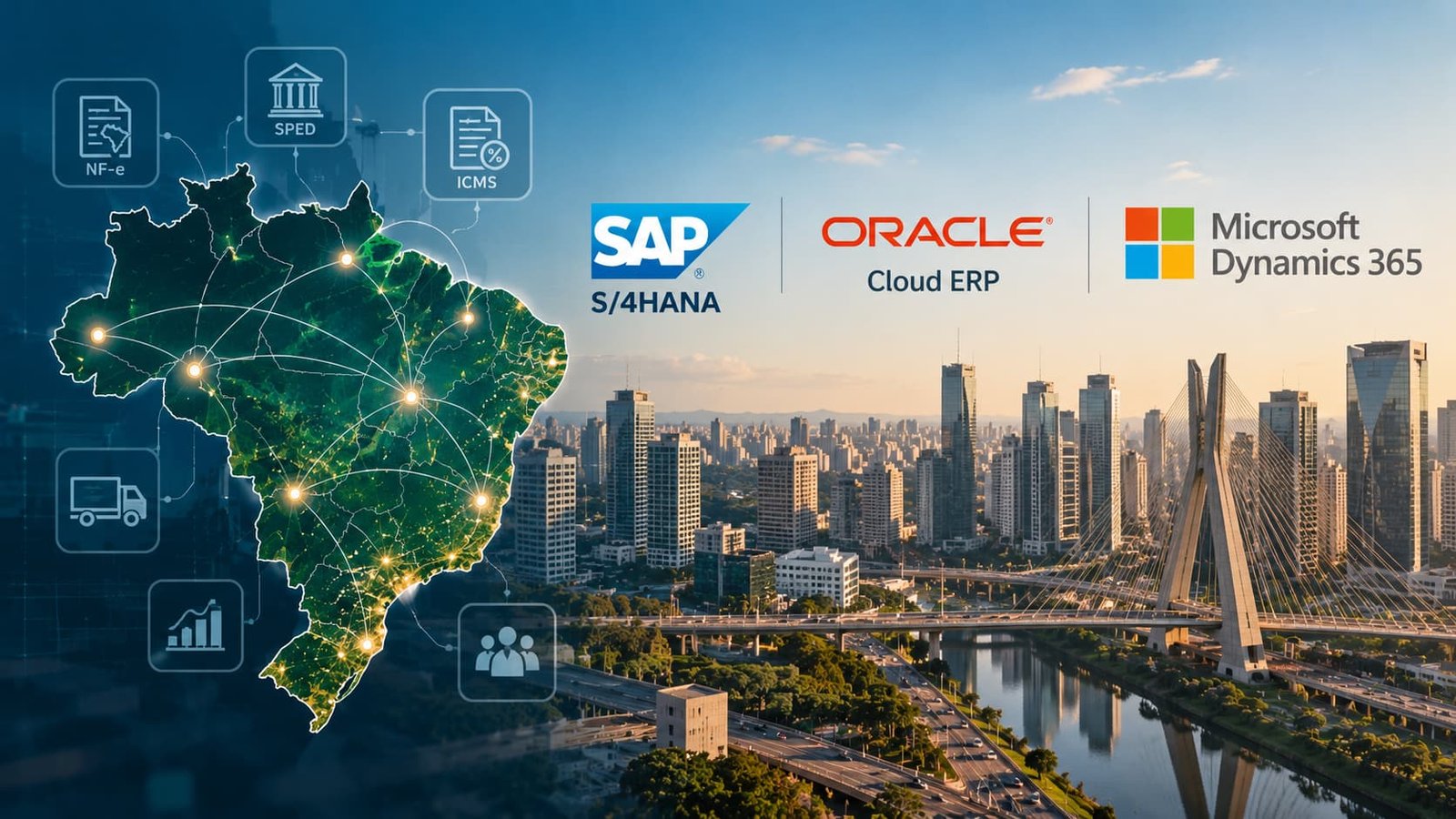
Rolling out a global ERP system in Brazil isn’t a matter of taking your country template and adapting a few fields. Brazilian tax and fiscal rules are built directly into business processes: tax determination, invoicing, procurement, sales, inventory, logistics and financial reporting all run through them. Get the Brazilian configuration wrong, and it isn’t a finance problem. It’s an operational one.
This guide looks at what makes Brazil different, where that complexity shows up in the ERP, and how to design a rollout that keeps the Brazilian operation connected to your global architecture instead of running around it.
Brazil Is Not Just Another Country Rollout
A global ERP implementation is usually built around a standardised template: core processes, master data structures, financial controls and reporting are defined centrally and adapted locally where needed. In most countries, that adaptation is a finishing step.
In Brazil, it’s a structural one. Tax and fiscal requirements are woven into the operational transaction itself, so local requirements reach into sales, purchasing, inventory, logistics and invoicing, not just the finance module. A Brazilian rollout has to satisfy two objectives at once: keep the company’s global ERP standards intact, and build in the local functionality Brazil demands to run at all.
That means answering a set of design questions before implementation starts, not during testing. Which processes stay on the global template? Which need Brazil-specific configuration? What master data needs Brazilian classifications? Do fiscal authorities and local systems need integration? Which statutory reports have to come out of the ERP itself?
Leave these questions for after the global template goes live, and you pay for it twice: once in rework across configuration, interfaces and data, and again in testing you already thought you’d finished.
Brazil’s Tax Complexity, Transaction by Transaction
Brazil’s tax system is the reason a Brazil rollout can’t be treated as a standard localisation. Tax determination here depends on far more variables than most markets require, and every variable sits inside the commercial transaction, not beside it.
| Area | Examples |
|---|---|
| Federal taxes | IPI, PIS and COFINS |
| State taxes | ICMS |
| Municipal taxes | ISS |
| Product classification | NCM |
| Fiscal operation | CFOP |
| Tax determination | Tax rates, tax bases, exemptions, reductions and other applicable rules |
What a product is, who’s buying it, who’s selling it, where both parties sit and how goods move between states all change the applicable tax. The ERP has to resolve this at the point of transaction, not after the fact. Product and customer master data carries the information tax determination runs on. Sales orders, purchase orders and inventory movements each generate transactions that need the right fiscal treatment applied immediately, and that treatment flows straight into invoicing and the general ledger.
Change the fiscal classification of a single product, and the effect reaches pricing, order processing, inventory, invoicing and accounting in one move. This is why Brazilian tax logic belongs in the process design, master data model and configuration from day one. It is not a localisation layer you bolt on once the global template is finished.
Electronic Invoicing: The Fiscal Document Is the Transaction
The invoice isn’t a record of what happened. It’s part of what makes the transaction legal.
| Fiscal document | Main application |
|---|---|
| NF-e | Sales and other transactions involving goods |
| NFS-e | Provision of services |
| CT-e | Transport services |
| MDF-e | Transport and logistics documentation |
The Nota Fiscal Eletrônica (NF-e) is the clearest example. The ERP builds the fiscal data, sends it to the relevant state tax authority (SEFAZ) for authorisation, and only once that comes back does the transaction count as valid. No authorisation, no sale.
That puts a direct line between your ERP and Brazil’s fiscal infrastructure. Product classifications, tax codes, quantities, values, origin and destination, the parties involved and the nature of the operation all have to be right before the document is even submitted. The ERP’s job doesn’t stop at generating an invoice. It has to produce correct fiscal data, talk to government systems in real time, process what comes back and keep the resulting documentation and status current. Build or configure that incorrectly, and transactions stall at the authorisation step, not in a report somewhere downstream.
One Localisation, Every Major Platform
SAP, Oracle and Microsoft Dynamics all ship dedicated Brazil localisations, and that tells you something: this isn’t a quirk of one vendor’s platform. It’s what the Brazilian fiscal environment demands of any ERP.
Take SAP as the example. Its Brazil localisation handles tax determination, Nota Fiscal processing, electronic fiscal documents and the fiscal data Brazilian transactions require, and it reaches well past finance, into sales, purchasing, materials management and inventory. A sales transaction in SAP Brazil isn’t “determine a price, post revenue.” It’s determine the applicable taxes, apply the correct fiscal classifications, generate the Nota Fiscal data and carry the transaction through electronic authorisation, every single time. Purchasing and inventory movements work the same way: the fiscal treatment depends on what’s moving and how, so the Brazilian data has to be present throughout the process, not added at the end.
That’s the real distinction between a global template and a country localisation. The template gives you standardised processes and controls. The localisation gives those processes the local functionality to actually execute inside Brazil’s fiscal system.
One Change Ripples Across the Whole System
Because fiscal rules are tied to the transaction, Brazilian localisation reaches well past finance and tax.
| ERP area | Brazilian requirements and considerations |
|---|---|
| Sales | Tax determination, fiscal classifications, NF-e generation |
| Purchasing | Supplier data, tax treatment, inbound fiscal documents |
| Inventory | Fiscal treatment of goods movements and transfers |
| Logistics | State-to-state transactions, transport documentation |
| Finance | Tax postings, accounts receivable/payable and statutory reporting |
| Master data | NCM, CFOP-related information, tax classifications and other local attributes |
| Reporting | SPED and other Brazilian statutory requirements |
A typical sales process connects customer master data, product classification, pricing, tax determination, inventory, invoicing and financial posting into a single chain. Touch one link, and the rest move with it. That’s why Brazilian requirements can’t sit with a dedicated tax or accounting team. They need to be consistent across every module, every piece of master data and every interface the transaction passes through, from first entry to final posting.
Global Template vs. Local Requirements
The central design question in a Brazil rollout is how much of the global template survives contact with Brazilian reality, and the answer is: most of it, if you draw the line correctly.
Your global template defines core processes, organisational structures, master data principles, financial controls and reporting standards, and those standards matter for governance and consistency across the group. Brazil doesn’t replace that template. It adds what the template can’t provide, because Brazilian fiscal and regulatory requirements simply don’t fit inside a standard global design.
The goal isn’t a separate Brazilian ERP running in isolation. It’s a Brazilian operation that stays connected to the global architecture while carrying the local functionality it needs to process transactions correctly. That means drawing a clear line early: processes untouched by Brazilian regulation stay on the global template, processes touched by Brazilian tax, fiscal documentation or statutory reporting get local configuration and integration. Master data follows the same logic. Keep the global structure where you can, and add Brazilian fiscal classifications and tax attributes where you must.
Done well, this isn’t a trade-off between standardisation and localisation. It’s a map of where each one applies, and how they connect.
The Tax Reform Moves the Target
None of this is static. Brazil is replacing PIS, COFINS, ICMS and ISS with a new dual VAT, CBS and IBS, plus a Selective Tax, in a transition running from 2026 to 2033. For a rollout happening now, that means designing for a moving target, not a fixed one.
The practical impact on ERP systems is already visible. Since 1 August 2026, electronic tax documents (NF-e and NFC-e) have had to carry dedicated CBS, IBS and Selective Tax fields under Technical Note NT 2025.002, with validation rules phasing in through the second half of the year. CBS collection starts in 2027, when PIS and COFINS disappear, and ICMS and ISS phase down against IBS between 2029 and 2032. The reform also introduces split payments, where part of each invoice is routed automatically to the tax authority at the moment of payment, and moves the whole system to destination-based taxation, which eventually removes mechanisms like DIFAL and ICMS-ST that current ERP configurations are built around.
For SAP customers specifically, this touches sales pricing (RVABRA/RVXBRA), purchasing tax procedures (TAXBRA/TAXBRJ), new IBS/CBS/IS fields in the NF-e, new CFOPs and mandatory fiscal text, across billing, inventory, accounting and fiscal bookkeeping. For Oracle EBS customers, only version 12.2.6 and above will receive CBS/IBS compliance patches at all. A Brazil rollout that doesn’t account for the reform isn’t future-proof on day one. It’s already behind.
Integration, Data and Reporting
The Brazilian ERP environment never operates on its own. Beyond your global systems, it has to talk to local fiscal infrastructure and the external platforms that authorise and report transactions, which means integration requirements your other country rollouts probably didn’t have.
Master data carries most of the weight here. Brazilian fiscal classifications and tax attributes have to be present the moment a transaction is created, because incomplete or inconsistent data breaks tax determination, invoicing and reporting downstream, not just the first time but every time. The architecture also has to separate what feeds global reporting from what feeds Brazilian statutory reporting, since the same transaction can serve both and still need different structures or transformations to do it.
Get this right and global systems keep receiving what they need for group reporting, while the Brazilian environment absorbs the local fiscal requirements the global template was never built for, without duplicating business logic in both places. This is architecture work, not a technical afterthought bolted on once the functional build is done.
A Practical Approach to Rollout
Start with the architecture, not the configuration. Map the Brazilian business processes first, and pin down exactly where local tax and fiscal rules change the global process design, across sales, purchasing, inventory, logistics, invoicing and finance.
From there, define the local functionality you actually need: tax determination, fiscal classifications, electronic fiscal documents, statutory reporting and the integrations that connect your ERP to Brazil’s fiscal infrastructure. Handle master data at the same stage, not after, so Brazilian products, customers, suppliers and operations carry the fiscal information each transaction needs from the start.
Testing has to follow the full transaction, not just the ERP step. That means tracing it from the initial business transaction through tax determination, fiscal document generation, external authorisation, financial posting and reporting, every time, because a transaction that passes the ERP test and fails at SEFAZ authorisation hasn’t actually passed. Finally, assess the Brazilian solution as part of your wider enterprise architecture, with interfaces to global ERP systems, reporting platforms and other corporate applications designed alongside the local components, not after them.
Done this way, the Brazilian operation stays aligned with your global ERP landscape and still has everything it needs to operate inside Brazil’s fiscal environment, through this transition and the next one.
Supporting Your Brazil ERP Rollout
At Ipanema International, we help international companies establish and grow their operations in Brazil, combining market entry, business development and local operational support with expertise in business processes, ERP and enterprise architecture.
If you’re implementing or adapting an ERP environment for Brazil, we help you assess the local requirements, map the impact on your existing processes and systems, and define an approach that connects the Brazilian operation to your wider enterprise architecture, tax reform included.
Planning an ERP rollout in Brazil, or scoping the requirements for a Brazilian subsidiary? Get in touch to talk through your situation and the right approach.