

Brazil is undertaking the most significant reform of its tax system in decades. The reform is designed to simplify the country’s complex system of consumption taxes and replace several existing taxes with a new value-added tax (VAT) model.
For businesses operating in Brazil, however, the transition will be far more than a change in tax rates. It will affect pricing, invoicing, supply chains, contracts, cash flow and the way companies manage their tax and ERP systems.
The new system will be introduced gradually between 2026 and 2033, meaning companies will have to operate within a changing tax environment for several years. Understanding what is changing, when it will happen and how it may affect your business is therefore essential for both companies already active in Brazil and those planning to enter the market.
This guide explains the Brazilian Tax Reform in practical terms, covering the new tax structure, the transition period and the implications for businesses and investors.
In This Guide
- Why Brazil Is Reforming Its Tax System
- How Brazil’s Tax System Works Today
- The New Tax Model at a Glance
- The New Taxes: CBS, IBS and Selective Tax
- What Taxes Are Being Replaced?
- The Transition Period: 2026–2033
- How the New VAT System Will Work
- Impact on Different Types of Businesses
- Special Tax Regimes and Exceptions
- What Changes for Foreign Companies
- Impact on Pricing, Contracts and Business Models
- ERP, Invoicing and Compliance Implications
- What Companies Should Do Now
- Conclusión
Why Brazil Is Reforming Its Tax System
Brazil has one of the most complex consumption tax systems in the world. Taxes on goods and services are currently levied at federal, state and municipal levels, with different rules, rates and calculation methods applying to different types of transactions.
The current system includes several major consumption taxes, including PIS, COFINS, IPI, ICMS and ISS. The interaction between these taxes, together with numerous sector-specific rules and tax incentives, has created a system that is difficult to administer and results in significant compliance requirements.
The Tax Reform seeks to restructure this system by consolidating the taxation of goods and services into a new value-added tax (VAT) model. The reform introduces two main taxes: the federal Contribution on Goods and Services (CBS)and the state and municipal Tax on Goods and Services (IBS). A separate Selective Tax (IS) will apply to certain goods and services.
The reform also introduces a number of structural changes to the way consumption taxes are calculated and collected. These include a broader system of tax credits, the adoption of the destination principle and greater uniformity in the taxation of goods and services.
The new system will not be introduced at once. Brazil has established a transition period running from 2026 to 2033, during which the existing and new tax systems will operate alongside each other before the new model becomes fully effective.
How Brazil’s Tax System Works Today
Brazil’s current consumption tax system is divided between the federal government, the states and the municipalities. Different taxes apply depending on what is being sold, where the transaction takes place and the nature of the activity.
At the federal level, PIS and COFINS are levied on revenues and certain transactions involving goods and services. IPIapplies primarily to industrialised products. At the state level, ICMS is the main tax on the circulation of goods and certain services, while municipalities levy ISS on services.
These taxes operate under different rules. Their tax bases, rates, credit mechanisms and calculation methods can vary considerably. In addition, businesses may be subject to different regimes and sector-specific provisions depending on their activities.
One of the central characteristics of the current system is the distinction between taxes levied at different stages of the supply chain. Tax credits may be available for certain inputs, but the rules governing these credits differ between taxes and types of transactions. This can result in taxation being carried through the supply chain rather than being applied solely to the final consumption of a product or service.
The system also contains significant differences between states and municipalities. ICMS rules, rates and incentives can vary from one state to another, while ISS is determined at the municipal level. This adds another layer of complexity to transactions that cross regional boundaries.
The Tax Reform seeks to replace this fragmented structure with a more standardised system based on a dual VAT model. Understanding the existing structure is therefore important for understanding the changes introduced by the reform.
The New Tax Model at a Glance
The Tax Reform replaces the current system of multiple consumption taxes with a new model based on three main taxes: CBS, IBS and the Selective Tax (IS).
The core of the new system is a dual value-added tax (VAT). CBS will be administered at the federal level, while IBS will be administered jointly by the states and municipalities. Both taxes are designed around a common structure and will generally apply to the same taxable transactions.
The reform also introduces the Selective Tax (IS). Unlike CBS and IBS, which form the general consumption tax system, IS is intended to apply to specific goods and services considered harmful to health or the environment.
A central change is the move towards taxation based on the destination of consumption. Under the new model, tax revenue will increasingly follow where goods and services are consumed rather than where they are produced or supplied.
The new system is also designed around a broader credit mechanism. Businesses will generally be able to recover tax paid on eligible purchases through credits, reducing the cascading effect that can occur when taxes are repeatedly embedded in the supply chain.
The main elements of the new model can therefore be summarised as:
- CBS – federal value-added tax
- IBS – state and municipal value-added tax
- IS – selective tax on specific goods and services
- Destination principle – taxation moves towards the place of consumption
- Tax credits – taxes paid on eligible inputs can generally generate credits
- Gradual transition – the new model is introduced between 2026 and 2033
The New Taxes: CBS, IBS and Selective Tax
The new Brazilian consumption tax system is built around three taxes: CBS (Contribuição sobre Bens e Serviços), IBS (Imposto sobre Bens e Serviços) y el Selective Tax (Imposto Seletivo).
CBS and IBS form the core of the new VAT system. Although they are administered at different levels of government, they are designed to follow broadly aligned rules and to operate together as a dual VAT.
CBS – Contribution on Goods and Services
CBS is a federal tax that will replace the current PIS and COFINS contributions. It will apply to the supply of goods and services and will operate under a non-cumulative credit system.
IBS – Tax on Goods and Services
IBS is a state and municipal tax that will replace ICMS and ISS. It will apply to the same broad range of transactions as CBS and will follow the destination principle, meaning taxation will increasingly be allocated to the location where consumption takes place.
Selective Tax
El Selective Tax (IS) is separate from the VAT system. It is designed to apply to specific goods and services that are considered harmful to health or the environment.
Unlike CBS and IBS, the Selective Tax is not intended as a general tax on consumption. It is therefore possible for a transaction to be subject to CBS and IBS while the Selective Tax applies only where the relevant product or service falls within its scope.
Together, these three taxes form the foundation of Brazil’s new consumption tax structure. Their introduction will gradually replace the existing federal, state and municipal consumption taxes during the transition period.
What Taxes Are Being Replaced?
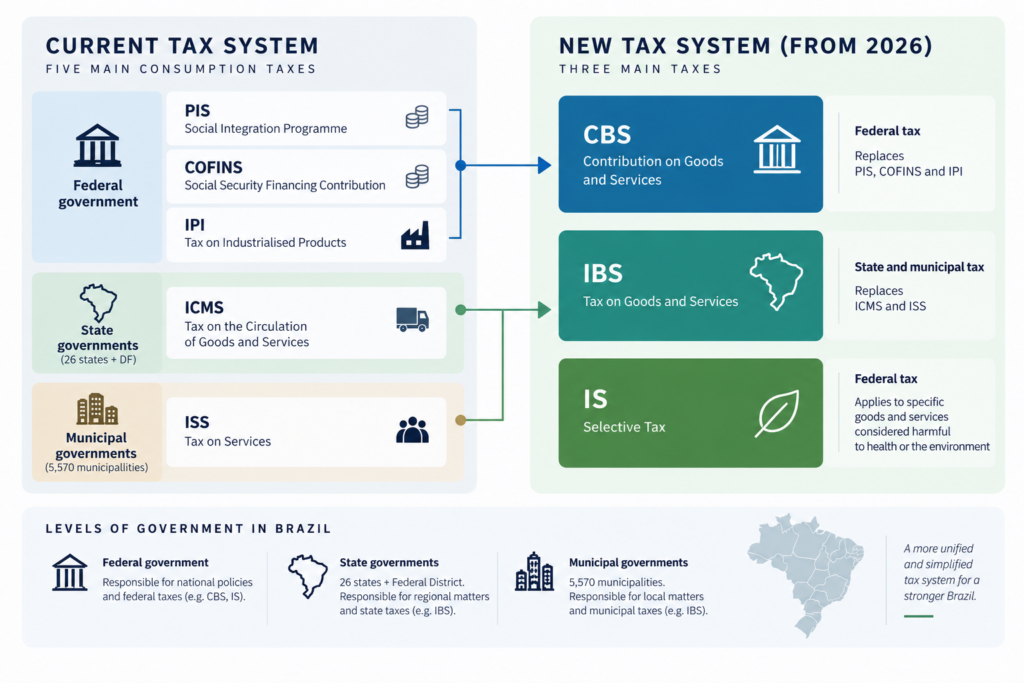
Figure 1. Brazil’s current consumption taxes and their transition to the new CBS, IBS and Selective Tax framework.
The Transition Period: 2026–2033
The new tax system will be introduced gradually rather than replacing the existing system overnight. The transition begins in 2026 and runs through 2033, with different taxes being phased out at different stages. During this period, businesses will need to operate within a changing tax framework as the new taxes are introduced and the existing taxes are progressively reduced.
2026: The Test Year
2026 is the initial testing year for CBS and IBS. The indicative rates are 0.9% for CBS y 0.1% for IBS, with the amounts collected being offset against PIS and COFINS and, under the applicable rules, other federal taxes.
The year is intended to allow the tax authorities, businesses and systems involved in the new model to be tested and adjusted before the main transition begins. Businesses are also required to adapt their electronic tax documents to identify CBS and IBS.
2027–2028: CBS Becomes Effective
From 2027, CBS enters into effect and PIS and COFINS are abolished. The Selective Tax (IS) is also introduced.
At the same time, the rate of IPI is reduced to zero for almost all products, with an exception for products that are also manufactured in the Manaus Free Trade Zone.
IBS also continues during this period at a transitional rate while the existing state and municipal taxes remain in place.
2029–2032: ICMS and ISS Gradually Give Way to IBS
The next stage concerns the state and municipal taxes ICMS and ISS. Between 2029 and 2032, their rates will be progressively reduced while the IBS component increases.
| Year | IBS | ICMS & ISS |
|---|---|---|
| 2029 | 10% | 90% |
| 2030 | 20% | 80% |
| 2031 | 30% | 70% |
| 2032 | 40% | 60% |
| 2033 | 100% | 0% |
These percentages describe the transition proportions, rather than the applicable tax rates themselves. The purpose is to gradually transfer taxation from ICMS and ISS to IBS.
2033: The New System Takes Full Effect
En 2033, the transition is completed and the new consumption tax model becomes fully operational. ICMS and ISS cease to exist, while CBS and IBS operate under the new framework. IPI is also largely phased out, subject to the specific treatment applicable to the Manaus Free Trade Zone.
The result is a transition spread over seven years, with the federal component changing relatively quickly from 2027 onwards and the state and municipal component moving more gradually towards IBS between 2029 and 2033.
How the New VAT System Will Work
The new system introduces a dual VAT model based on CBS and IBS. Although these taxes are administered by different levels of government, they are designed to follow similar principles and operate under a common framework.
One of the most important changes is the move towards full taxation based on the destination of consumption. Under the current system, the tax treatment of a transaction can depend significantly on where goods are produced, sold or services are provided. Under the new model, tax revenue will increasingly be allocated to the location where the final consumption takes place.
The new system also uses a broader input tax credit mechanism. Businesses will generally be able to claim credits for CBS and IBS paid on eligible purchases and inputs. The tax is therefore intended to apply primarily to the value added at each stage of the supply chain, rather than accumulating through successive transactions.
The basic mechanism
A simplified example illustrates how this works:
A manufacturer purchases raw materials and pays CBS and IBS on those inputs. When the manufacturer sells the finished product, it charges CBS and IBS to the next party in the supply chain. The taxes paid on the raw materials can generally be claimed as credits against the taxes due on the sale.
This mechanism continues through the supply chain until the product or service reaches the final consumer. The final consumer does not receive a corresponding input tax credit, making consumption the ultimate point at which the tax is borne.
Destination-based taxation
The destination principle is another fundamental feature of the new system. Instead of allocating tax revenue primarily according to the location of production or supply, IBS will be attributed to the place of destination.
This is particularly relevant for transactions between different states and municipalities. Over time, the reform is intended to reduce the importance of tax competition between states and municipalities based on the location of economic activity.
Greater tax transparency
CBS and IBS are also intended to make the tax component of transactions more transparent. Rather than having several different consumption taxes embedded in the price of goods and services, the new system is structured around clearly defined VAT components.
The combination of a broader credit mechanism, destination-based taxation and more standardised rules is intended to create a more consistent method for taxing consumption throughout Brazil.
Impact on Different Types of Businesses
The impact of the Tax Reform will differ depending on the nature of the business, its activities and the way goods or services move through the supply chain. The new system introduces common principles, but specific rules and tax treatments will continue to apply to different sectors.
Manufacturing
Manufacturers will see changes in the way taxes are applied throughout their supply chains. The broader credit mechanism under CBS and IBS is intended to reduce the accumulation of taxes between production stages. The treatment of industrial products will also change as IPI is largely phased out, while the Selective Tax may apply to specific products.
Retail and Distribution
Retailers and distributors will operate under the new CBS and IBS framework as the existing consumption taxes are gradually replaced. The destination principle will become particularly relevant for transactions involving sales across different states and municipalities.
Services
The reform changes the taxation of services currently subject to ISS, PIS and COFINS. Services will generally fall within the CBS and IBS system, although specific rules and reduced rates may apply to certain sectors.
Technology and Digital Businesses
Digital products and services will be incorporated into the broader CBS and IBS framework. The reform’s broader definition of taxable transactions is relevant to business models involving digital services, platforms and other technology-based activities.
Agroindustria
Agricultural activities and food products are subject to specific provisions under the new system. Certain products and activities may benefit from reduced rates or other special treatment, reflecting the importance of the sector within the Brazilian economy.
Construction and Real Estate
The construction and real estate sectors receive specific treatment under the reform. Transactions involving real estate are subject to rules that differ from the standard CBS and IBS framework, including specific reductions and calculation mechanisms.
Financial Services
Financial services are also subject to a specific tax regime. Rather than simply applying the standard VAT mechanism, the reform establishes particular rules for determining the tax base and taxation of financial activities.
The result is a system in which the general principles of CBS and IBS apply broadly, while sector-specific regimes, reduced rates and other provisions determine the precise tax treatment of individual activities.
Special Tax Regimes and Exceptions
Although the Tax Reform establishes a broader and more standardised system for taxing goods and services, not all economic activities will be taxed under exactly the same rules. The legislation provides for specific regimes, reduced rates, exemptions and other special treatments for certain sectors and types of transactions.
These provisions are intended to take account of the particular characteristics of specific activities or their economic and social importance. As a result, the standard CBS and IBS rules do not tell the complete story for every business.
Simples Nacional
Simples Nacional, Brazil’s simplified tax regime for micro and small businesses, will continue to exist under the new system. Businesses within the regime will have specific rules governing how CBS and IBS are treated, including the way tax credits can be generated and transferred within the supply chain.
Reduced Rates and Zero Rates
Certain goods and services will benefit from reduced CBS and IBS rates, while specific categories may be subject to a zero rate. The reform includes preferential treatment for areas such as healthcare, education, food and other activities defined by law.
The extent of these reductions varies by sector and is an important part of determining the effective tax burden under the new system.
Specific Tax Regimes
Some sectors will operate under specific calculation and collection mechanisms rather than the standard VAT model. These include areas such as financial services, fuels, real estate and certain activities within the agricultural and food sectors.
The reform therefore combines a general VAT framework with targeted rules for sectors where a standard model is considered unsuitable or where specific policy objectives apply.
Manaus Free Trade Zone
El Manaus Free Trade Zone (Zona Franca de Manaus) receives specific treatment under the reform. This reflects the existing economic and regional policies associated with the zone and means that the transition of certain taxes, particularly IPI, does not follow exactly the same path as in the rest of Brazil.
Selective Tax
El Selective Tax (IS) represents another important exception to the general VAT structure. It will apply to specifically defined goods and services considered harmful to health or the environment. It is therefore possible for a product or service to be subject to CBS and IBS and, where applicable, also to the Selective Tax.
The result is a system that is more standardised than the current structure, but not entirely uniform. Understanding the applicable regime, reductions and sector-specific provisions will remain essential when determining the actual tax treatment of a transaction.
What Changes for Foreign Companies
Foreign companies with activities in Brazil will be affected by the Tax Reform through changes to the taxation of local transactions, imports, services and business operations. The precise impact will depend on the structure and nature of the activities carried out in Brazil.
Brazilian Entities
Companies established in Brazil will transition from the existing consumption tax framework to the new CBS and IBS system. This will affect the calculation of taxes on sales and purchases, the treatment of tax credits and the allocation of tax on transactions.
Imports
The reform also changes the taxation of imported goods and services. Imported transactions will generally be subject to CBS and IBS under the same broad consumption-tax principles that apply to domestic transactions. The destination principle means that taxation is linked to consumption in Brazil rather than the location of production.
Services Supplied from Abroad
Services supplied by a foreign entity to a recipient in Brazil can also fall within the new tax framework. The rules determine when CBS and IBS apply to transactions involving foreign suppliers and how the corresponding tax obligations and credits are treated.
Intercompany Transactions
Transactions between related companies will need to be considered within the new framework. The Tax Reform does not replace Brazil’s separate transfer pricing rules, but consumption taxes can form part of the overall cost and tax analysis of intercompany transactions.
Tax Credits
The new credit mechanism can change the economics of transactions within a multinational supply chain. The availability of CBS and IBS credits will depend on the nature of the transaction and the applicable rules, making the treatment of purchases, imports and intercompany services particularly relevant.
Compliance and Local Operations
The transition will also require changes to tax calculation, electronic invoicing, accounting processes and other compliance procedures. Companies operating through Brazilian subsidiaries, branches or other local structures will therefore need to incorporate the new requirements into their local operations.
The Tax Reform does not create a separate tax system for foreign-owned businesses. The same CBS and IBS framework applies based on the nature and location of the transaction, while specific rules determine how cross-border transactions are treated.
Impact on Pricing, Contracts and Business Models
The Tax Reform can affect the way businesses determine prices, structure commercial agreements and calculate margins. The introduction of CBS and IBS changes how consumption taxes are charged throughout the supply chain, while the broader credit mechanism changes the way tax costs can flow between businesses.
Pricing
The transition to the new system may change the tax component included in the price of goods and services. The effect will differ between sectors and individual businesses depending on their current tax treatment, the availability of tax credits and the applicable rules under the new system.
During the transition period, companies may also need to account for both the existing and new tax structures when determining prices.
Commercial Contracts
Long-term contracts may require particular attention during the transition. Changes in applicable taxes can affect the total cost of a transaction even where the underlying price remains unchanged.
Contracts may therefore need to address how changes in taxation are reflected in prices, payments and other commercial terms.
Margins and Business Models
Because the reform changes both the taxation of sales and the treatment of business inputs, its impact cannot be assessed simply by comparing old and new tax rates.
Businesses may experience changes in their effective tax burden depending on their position in the supply chain, the proportion of taxable inputs they purchase and the extent to which they can claim tax credits.
Supply Chains
The new destination-based system and broader credit mechanism may also influence the economics of supply chains. Companies may reassess sourcing, distribution and transaction structures as the new rules are phased in.
The overall impact will therefore depend on the specific business model and how transactions are structured. A company facing a higher nominal tax rate, for example, does not necessarily face a higher effective tax burden if its ability to recover taxes paid on inputs also changes.
ERP, Invoicing and Compliance Implications
The Tax Reform will require significant changes to the systems and processes used to calculate, record and report consumption taxes. This includes accounting systems, ERP platforms, electronic invoicing and other fiscal technology.
Electronic Invoicing
Brazil’s electronic invoicing system will need to accommodate the new tax structure. Invoices will progressively include information relating to CBS and IBS, alongside the existing taxes during the transition period.
This means that businesses will need to ensure that their invoicing systems can correctly calculate and display the applicable taxes throughout the different stages of the transition.
ERP and Tax Configuration
ERP systems will require updates to reflect the new tax rules. Tax codes, rates, calculation logic, fiscal classifications and credit mechanisms will all need to be reviewed.
For companies with complex operations, this can involve changes across multiple processes, including:
- Purchasing and accounts payable
- Sales and accounts receivable
- Inventory management
- Pricing
- Tax calculation
- Facturación electrónica
- Accounting and reporting
Master Data and Fiscal Classification
The reform also increases the importance of accurate product and service classification. The applicable tax treatment can depend on the nature of the transaction and whether a product or service qualifies for a specific regime, reduction or exemption.
Companies will therefore need to review relevant master data and ensure that products, services, suppliers and customers are correctly classified in their systems.
Testing During the Transition
Because the new and existing tax systems will overlap during the transition, businesses will need to test their systems well before each stage takes effect. This includes testing tax calculations, invoices, accounting entries, credit mechanisms and reporting.
The transition therefore represents not only a fiscal change but also a significant systems and process transformation. Companies that rely on ERP and automated invoicing will need to progressively adapt their technology landscape to support the new tax model.
What Companies Should Do Now
The transition to the new tax system will take several years, but businesses need to prepare before the existing taxes are fully replaced. Changes to tax calculations, invoicing, contracts, pricing and internal systems will need to be implemented progressively throughout the transition period.
A structured approach can help businesses identify the areas that require attention and avoid last-minute adjustments.
1. Map the Current Tax Position
Start by identifying which taxes currently apply to the business, its products and services, and its main types of transactions. This provides a baseline against which the impact of the new system can be assessed.
2. Assess the Impact of CBS and IBS
Analyse how the new tax model will affect sales, purchases, tax credits and effective tax costs. This should take into account applicable reduced rates, exemptions and sector-specific regimes.
3. Review Pricing and Contracts
Assess whether changes in taxation could affect prices, margins or contractual arrangements. Long-term agreements should receive particular attention where tax changes could alter the economics of existing transactions.
4. Prepare ERP and Invoicing Systems
Review tax configuration, fiscal classifications, electronic invoicing and reporting requirements. Systems should be tested against the different stages of the transition rather than only against the final 2033 model.
5. Review Supply Chains
Consider how changes to the credit mechanism and destination-based taxation could affect purchasing, production and distribution structures.
6. Model Different Scenarios
The impact of the reform will vary between businesses. Financial modelling can help identify potential changes in tax costs, margins and cash flow under different assumptions.
7. Monitor Regulatory Developments
The transition will involve further regulations, technical specifications and implementation guidance. Businesses should continue to monitor these developments and update their implementation plans accordingly.
Preparation is therefore not a single exercise. It is a multi-year process that should evolve as the new tax system is progressively implemented.
Conclusión
Brazil’s Tax Reform represents a fundamental restructuring of the country’s consumption tax system. The existing combination of federal, state and municipal taxes will gradually give way to a dual VAT system based on CBS and IBS, complemented by the Selective Tax.
The transition will take place over several years, with important changes starting in 2026 and the new system becoming fully effective in 2033. During this period, businesses will need to adapt to new rules while continuing to operate under parts of the existing system.
The reform is intended to create a more consistent and transparent framework for taxing consumption. Its practical effects, however, will vary between sectors and business models, particularly where special regimes, reduced rates or specific tax treatments apply.
For businesses operating in Brazil, the reform is therefore not simply a future change in taxation. It is a gradual transformation that affects taxation, commercial processes, technology and business planning. Understanding the new framework and preparing for each stage of the transition will be essential as Brazil moves towards its new consumption tax system.